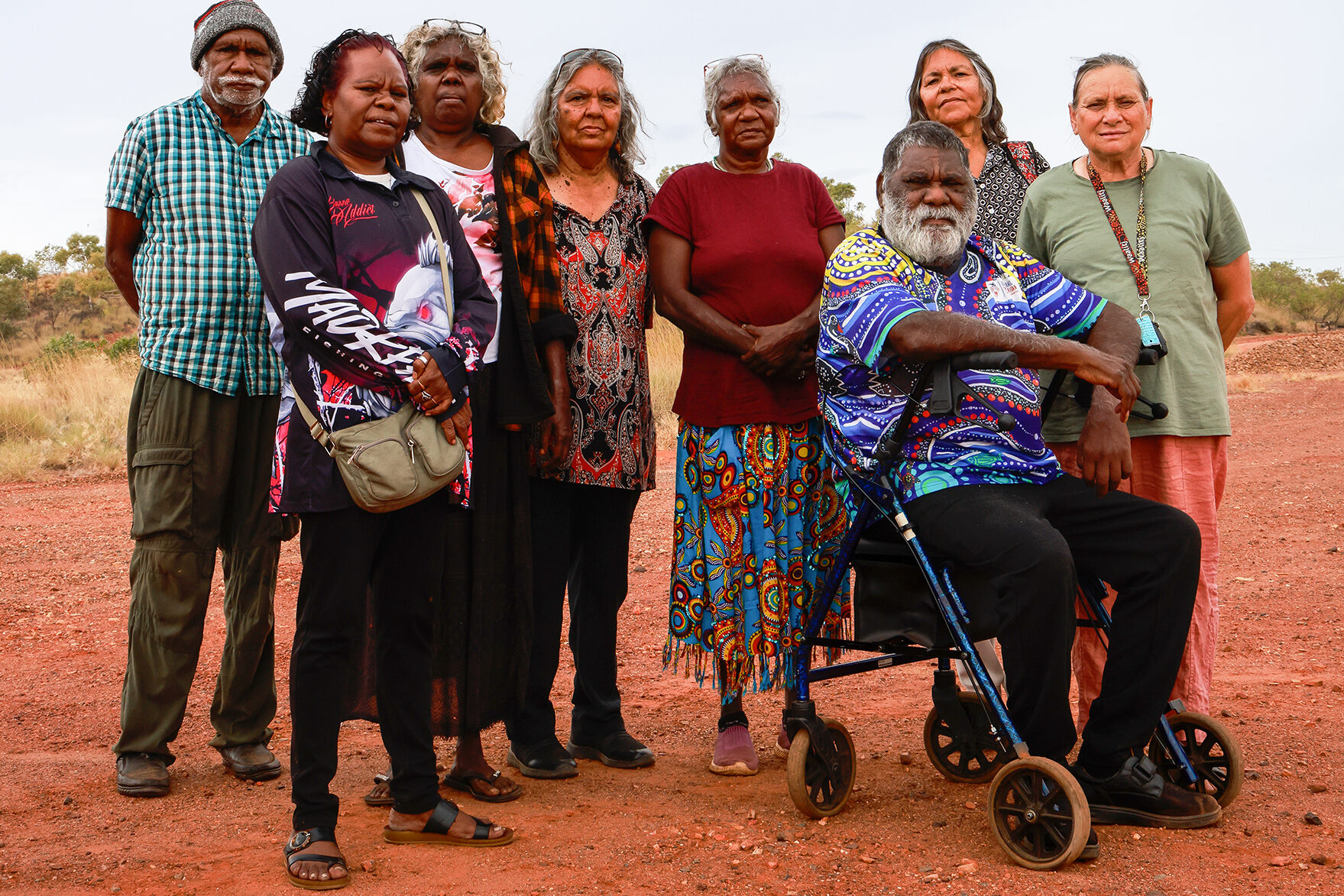

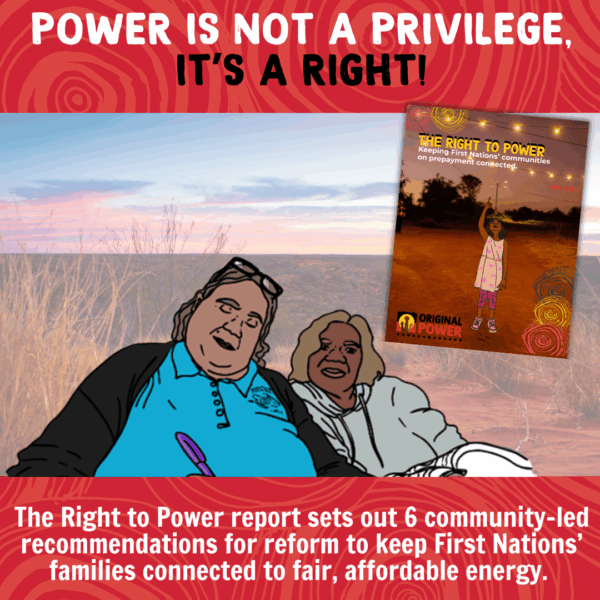
The Central Land Council has called on governmentsto reform electricity prepayments to keep remote Aboriginal people connected to power.

Remote community residents prepay for their electricity, while most Australians enjoy the flexibility of post-pay arrangements, and can access hardship protections when needed.

Remote community residents pre-paying for their electricity, don’t get adequate warning before their power cuts out. While for most Australians, disconnections are rare, they are a regular event in remote NT Aboriginal communities.

Research by community organisation Original Power found that remote NT Aboriginal households suffer on average 59 disconnections a year. By contrast, households in remote South Australian Aboriginal communities averaged 14 disconnections due to their tariff being a third of what’s charged in the Northern Territory and have an automatic application of concession payments and other wrap around supports.

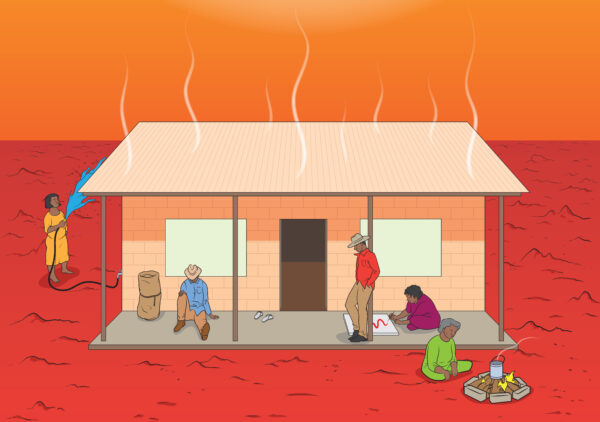
At a meeting of their full council in Yulara last week, Central Land Council members heard disconnections rise dramatically in the NT when temperatures hit 40 degrees Celsius.

The Central Land Council’s delegates fully endorsed the recommendations in Original Power’s report, Right to Power: Keeping First Nations Communities Connected on Prepayment. 

Central Land Council General Manager, Dr Josie Douglas said, “The report looked at prepayment electricity across the Northern Territory, South Australia, Queensland and Western Australia and the evidence shows that the level of energy insecurity in remote NT is worse than anywhere in the country”.

“Closing the Gap target 9B commits governments to ensuring that by 2031, all first nations households receive the same level of essential services and consumer protections as all Australians regardless of where they live. To achieve this target, prepayment reform is critically needed.”

Council member Jimmy Frank Jupurrula from Tennant Creek said, “I would like to know why we don’t have the same power arrangements in the NT as they do in remote South Australia, we are remote too.”

Houses being built in communities aren’t designed to keep people warm in winter and cool in summer.

“When it’s hot, people stay inside and use more power, and most new houses only have one room with air conditioning. If the power gets cut off, we all go to a relative’s house where the power is on, this puts further stress on families. It creates overcrowding and you get issues with scabies and rheumatic heart disease.”

Council member Ingrid Williams from Santa Teresa said living in community is very expensive and power is her highest cost.

“We get cut off a lot.  We pay a lot for rent and for power. We have to cut back on money for food so we can have enough money for the power,” she said.
Download media release PDF

The Northern Territory’s land councils have told the federal government the Environment Protection Biodiversity Conservation Act must ensure big projects are subjected to the most stringent water and climate impact tests.

The land councils demand rigorous assessments be applied to big projects impacting on ground and surface water, not just to fracking and coal mining projects.

They are dismayed that they have not been consulted about the reform of federal environment laws.

“The very survival of our people on country is at stake. We are living the impacts of climate change and water insecurity now, and the forecasts for the North are devastating,” the acting chief executive of the Central Land Council, Dr Josie Douglas, said.

“Our communities are becoming uninhabitable, and the NT’s environment is also under pressure from thirsty development projects.”

“If now is not the time to heed our voices, when the federal government has unprecedented power and political capital, then when?”

“The voice referendum may have been lost but there is no excuse for failing to listen to us on laws that are existential for our survival as Aboriginal peoples.”

“So far, the debate on federal environment laws has been run as a closed shop between the large environment groups and industry. This has to stop. Our representative bodies must be heard now and engaged directly in the design of critical national environmental standards.”

“The Central Land Council called for this in its submissions to the federal environment department under former Environment Minister Tanya Plibersek and in recent correspondence from the Central Land Council and Northern Land Council to Minister Murray Watt,” she said.

Tiwi Land Council chair Leslie Tungatalum said strong national environmental protections are vital to protect environmental and cultural values on the Tiwi Islands – not just for Tiwi people, but for Australia as a whole.

“Our islands are rich and unique in biodiversity. With fewer impacts from legacy land uses compared to the mainland, the islands and surrounding waters are havens for many species and ecological communities that need protection.”

“Strong national environmental standards are vital for the resilience of ecological systems across the islands to protect them.”

Northern Land Council chair Matthew Ryan said: “Aboriginal people have legal rights and interest in 98 per cent of the land in the NT. We must be part of the conversation.”

“Our voices need to be heard for the future of country.”

“Our role is to consult with Aboriginal people across the NT on projects that are going to impact people’s lives and country, yet we have been ignored.”

“We represent the people who live on country. Our people need to prosper on our lands and our seas. We are the people who will be impacted directly by the proposed reforms to the EPBC Act.”

“We call upon Minister Watt to ensure that land councils are part of the conversation going forward, and we welcome his indication that he is willing to consider amendments.”

The land councils ask the minister to:

  • Expand the water trigger to all projects that have a significant impact on ground and surface water.
  • Ensure projects with major impacts on climate are subject to stringent climate risk assessments and decisions.
  • Retain decision-making powers over federal environmental laws
  • Consult with NT land councils on the development of the national environmental standards.
  • Extend the consultation period for establishing ‘development regions’ from the proposed 30 to 90 days to ensure land councils can facilitate free, prior and informed from traditional owners.
  • Ensure that Aboriginal cultural values are part of regional development planning and project assessment. This requires land councils to consult with the relevant traditional owners at all stages.


Download media release PDF

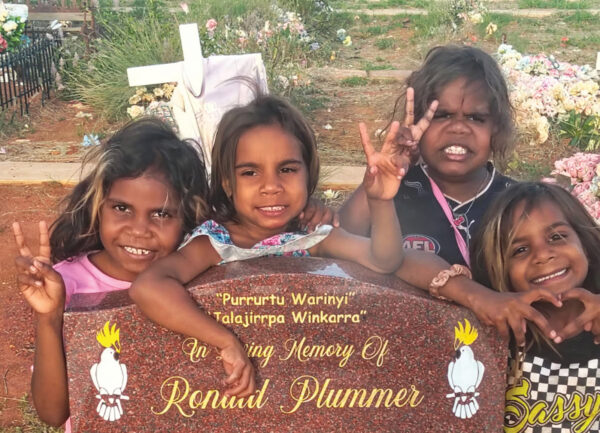
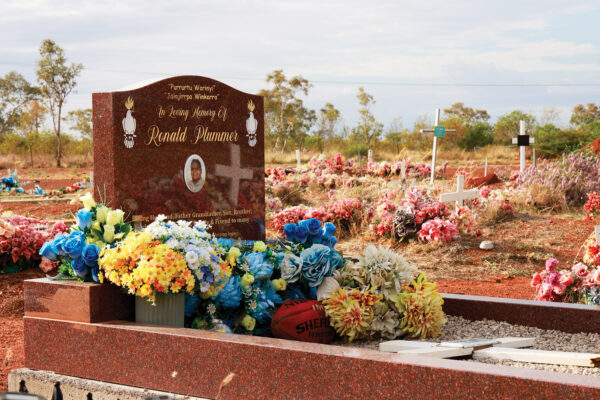
HONOURING the lives of loved ones with grave headstones has made the Plummer family happy they are recognising their heritage.

The graves of its seven family members in the Tennant Creek cemetery had become hard to find. Only one had a plaque.

In April Central Monuments Headstones installed headstones, vases and granite surrounds on all seven gravesites. The family drafted the words on the memorials.

Mr R Plummer, a prominent Tennant Creek resident, began planning the headstone project with his family and the Central Land Council’s community development team in 2022. After his death in 2023 the family wanted to continue his work to commemorate their ancestors and help keep their identity, culture and history alive.

“It’s about honouring family that are gone,” said Marlene Plummer. “Every time we come out [to the cemetery] we never see anything. Now we know where they are buried and we don’t have to go searching.”

The whole family was involved in the project and decorated the graves with flowers and added gravel, said Aden Plummer. “They felt proud doing their bit. Everyone helped out with the little things to finish and make it look good,” he said.

He credited the late Mr Plummer with getting the ball rolling. “If it wasn’t for him we probably wouldn’t have looked into it. He was the one that started doing the slabs as part of the mob project.

After the death of the late Mr R Plummer in 2023 the family wanted to continue his work
to commemorate their ancestors and help keep their identity, culture and history alive.

“He was always thinking about our family wanting to make headstones. The whole family feel happy with this, seeing their headstone on their parents’ [grave].

“It’s for the generations to come. They’ll come out here and look where my great grandfather is. He’s here with his brother. That’s what we were thinking,” he said.

The Purrurtu traditional owner (Plummer family) group funded the project with compensation income and matched funds from the Aboriginals Benefit Account.

Since 2020 the matched funds trial of the CLC and the National Indigenous Australians Agency has supported groups whose income from land use agreements would otherwise be too small for the projects they want to do.

Twenty-three traditional owner groups and 27 communities are taking part. The trial has been extended until 2026.

David McCormack said Yuelamu is taking action against expensive and unreliable power.

Rising temperatures and extreme weather are pushing up electricity costs, leaving more remote community households without power when they need it most.

Yuelamu’s Granites Mine Affected Area Aboriginal Corporation (GMAAAC) committee is setting up a community-owned solar microgrid to improve electricity supply to households. The committee is working with Original Power, which supports Aboriginal communities to move to renewable energy.

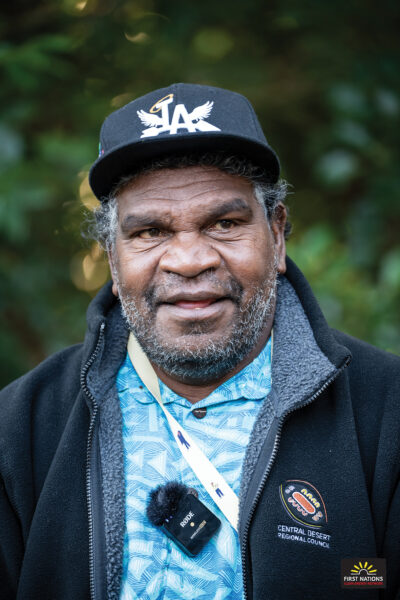
Yuelamu GMAAAC director and member of the Australian Government’s First Nations Clean Energy Advisory Committee, David McCormack, said residents cannot afford the high cost of rent and power.

“We use power cards, and when the money runs out we have no power. During extreme weather the power lines break and we are without power for 16 or 17 hours. This happens a lot.

“The food in the fridge goes bad and needs to be thrown away. People lose hundreds of dollars of food.”

GMAAAC director Cliffy Tommy, also from Yuelamu, said people can’t store their medications safely. “Some of my relatives have new kidneys and they need medication to be refrigerated.”

In summer Mr McCormack pays around $150 a week to cool two rooms in his home. “Air conditioning chews up a lot of money. That’s why we are looking at a community-owned microgrid to provide cheaper power to households.”

Original Power is studying how the community, three hours northwest of Mparntwe (Alice Springs), uses its power and what it would take to connect the microgrid to the Yuendumu power station, half an hour’s drive away.

The community is working with Original Power and other partners to understand the system load requirements and the grid’s capacity and power outputs.

Original Power will help the community identify government and other funding sources for the project.

While t h e r e a r e powe r disconnections throughout the year, when temperatures rise above 40 degrees disconnections also rise dramatically, especially in the NT.

Original Power used prepayment meter data to show that remote NT communities using prepayments averaged 55 disconnections per year while South Australia’s Anangu Pitjantjatjara Yankunytjatjara lands averaged 14 disconnections and remote Western Australian communities 33.

It said South Australia prepayment tariffs were fixed at 10 cents per kilowatt hour, compared with 31 cents in the NT.

Energy retailers in the NT are not required to report prepayment disconnections. As a result, energy insecurity in the territory is largely hidden.

The Central Land Council has called on the NT Utilities Commission to make power retailers report all disconnections in remote communities and apply the same electricity retail reporting requirements across the territory.

The NT-based Climate Justice Alliance predicts the NT is heating up dangerously. The Alliance’s Dr Ned Bible said she used publicly available Climate Council data to forecast how hot it will be in 72 Northern Territory communities by 2050 and 2090.

“It showed if we stay on our current path, by 2050 Alice Springs and Katherine would experience more than twice as many days over 40 degrees than now, and Darwin would have 92 more days over 35 degrees Celcius than currently.”

Dr Bible said remote communities in the north of the NT, such as Tennant Creek, were already suffering hotter days and nights as humid air from Darwin moved further south.

She said remote communities will be hit by the double whammy of extreme heat and unaffordable power. This combination will worsen chronic disease and increase the risk of heat stress, particularly for the elderly, the very young and those already sick.

The NT government is planning to replace 55 remote community diesel power stations with renewable energy. The CLC and the Northern and Tiwi land councils are working with the government to ensure the renewable energy transition benefits residents.

They want to bring the cost of power down so there are fewer disconnections. They also want residents to get training and jobs out of the construction and operation of the renewable energy.

CLC chief executive Les Turner said Aboriginal people need affordable power so they can survive and thrive on country as the climate heats up.

“Cheap and reliable power in communities like Yuelamu is essential to the health and wellbeing of families,” he said. “Our people are among the hardest-hit by man-made climate change and have done the least to contribute to it. It’s only fair that they are part of the clean energy transition.”

Yuelamu residents and Original Power are working on the development of microgrid to bring the cost of power down so there are few disconnections.
Lille Madden at the Mparntwe Telegraph Station where the ashes of her grandfather, Charles Perkins, were scattered.

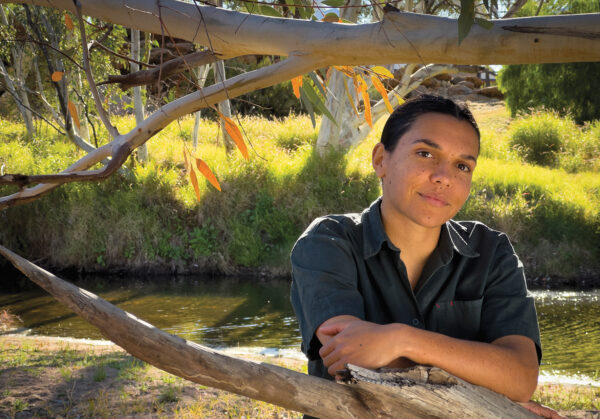
GROWING up in Sydney, Lille Madden loved spending time in nature with her family and watching National Geographic TV programs. It led the Arrernte, Bundjalung and Kalkadoon woman to study and work in conservation and land management and become a passionate advocate for the environment.

The quietly spoken daughter of art curator Hetti Perkins and granddaughter of the first Central

Land Council chair, the late Charles Perkins, Ms Madden is also a storyteller. She presented and cowrote Healing Country a three-part ABC social media series where she yarned with young Aboriginal people about what they were doing to protect their country.

Now the 30-year-old is helping women to stay on remote country and keep their connection to culture women’s land management facilitator.

Ms Madden, who worked as an NT Parks ranger at the Mparntwe (Alice Springs) Telegraph Station for more than two years before joining the CLC, will build women’s skills by identifying training and ranger exchange opportunities. She will support women to present about their research projects at conferences and will network widely to attract women to the CLC’s ranger program.

“Women hold a lot of responsibility to families, communities, country and culture and my role is to support them in land management and help employ and elevate women within the organisation,” she said.

Ms Madden also acknowledged the work of her predecessors, Kim Webeck and Fiona Webb.

“It’s really important to acknowledge that this role and its funding was hard-won by the women all throughout the Central Desert.

“The work is an opportunity to connect with remote communities to help keep their people healthy, culture strong, sacred sites protected for many more generations to come,” she said.

Ms Madden has met about half the CLC ranger groups and says working with women has been a powerful experience. “I feel very lucky to be able to work with some amazing knowledge holders who all share a similar vision, cause and passion for their country.”

Moving to Mparntwe three years ago was a big life decision. “It was very important for me to go back to my grandfather’s country to learn culture and remain connected to that place.

“Aboriginal culture sees everything as equal and the world would be a much better place if people had this understanding.

“I constantly think about what our elders both past and present have done for Aboriginal people and what our responsibilities are as the next generation.

“What will it be like for my future children as well as for all Aboriginal children? What’s their connection going to be? I want to keep that connection strong.”

Gerry Rice, Valerie Curtis, Arana Rice, Judith Swan, Valerie Nelson, Dawn Swan, Frankie Curtis and Verna Curtis believe the Singleton water licence will destroy too many sacred sites and the desert region’s native plants and animals that depend on its groundwater

“FINALLY, someone is listening,” was the immediate reaction of Dawn Swan to the High Court of Australia’s decision in September to hear the appeal against Singleton Station’s water licence.

“I am very happy. We have people living on the land and this is their dream to stay here for future generations,” Ms Swan, a native title holder for the station, said.

Fortune Agribusiness’ licence to extract 40 gigalitres of groundwater a year from the station, south of Tennant Creek, represents the largest amount of groundwater ever given away by the Northern Territory.

The Mpwerempwer Aboriginal Corporation, which represents native title holders, has argued the licence will destroy too many sacred sites and the desert region’s native plants and animals that depend on its groundwater.

Native title holders described the High Court’s decision as incredibly important.

“The reason why we are fighting is because the amount of water Fortune [Agribusiness] wants to take from our land is too much,” native title holder Valerie Curtis said.

“We’re happy to share the water, but to us it just seems like they want more than enough and it’s not fair on us. It’s not fair on our country. It’s not fair on our future generations,” she said.

“This has been a long journey, and we will continue to fight for our sacred sites and culture,” Ms Swan said.

The case is likely to be heard next year and, if successful, the water licence would be invalid and likely to be sent back to the NT minister to decide on again, but this time in accordance with the law.

The appeal does not stop the NT’s environmental approval process and Mpwerempwer and other affected traditional owners are working with the Central Land Council and Fortune Agribusiness, the lease holders of Singleton Station, on the environmental impact assessment.

Before the assessment is finished the company is not allowed to use the licence to extract groundwater.

“We want to make sure the study is done properly so that Fortune Agribusiness, the NT government and the Environment Protection Agency hear how deeply Aboriginal people fear the damage this much groundwater extraction could cause to their country and culture,” the CLC’s chief executive Les Turner said.

Mr Turner said Mpwerempwer’s decision to pursue the case to the High Court shows that “water rights are inseparable from land rights and go to the heart of protecting culture.”

The High Court will decide if the NT Court of Appeal was wrong when it found that the NT minister lawfully granted the licence.

It will consider if the minister properly took Aboriginal cultural values into account or properly considered if there were exceptional circumstances that justified a licence for 30 years. It will also consider if the native title holders were entitled to the same procedural fairness as Fortune Agribusiness.

For example, Fortune was given an opportunity to review the water licence condition before the licence was granted. Native title holders were not given a chance to review the condition about assessing cultural values.

Ms Curtis said she was very excited the court would hear their story.

“It makes me feel happy. We want to fight for our rights, our sacred sites and our country, to be heard and for it to be fair,” she said.

Central Land Council chair Warren Williams has welcomed the appointment of the Northern Territory’s first Alice Springs-based Police Commissioner, Martin Dole.

Mr Williams said he hopes the commissioner would use his policing knowledge from working in Yuendumu, Ti Tree and Alice Springs when building trust and confidence in the NT police.

He said he knew Mr Dole’s family in Yuendumu. “His father, a kind-hearted man, ran the local shop.”

“Martin Dole knows the issues and the people.”

Mr Williams believes Commissioner Dole’s connection with Aboriginal communities shaped his approach to community policing and engagement.

“During his seven months acting in the police commissioner role he has been respectful to our elected council members.

“He understands our region and as the regional controller for southern and northern emergency management he oversaw the response to the devastating Barkly fires in 2023.

“We stand ready to work together with Commissioner Dole on rebuilding community trust in the police force.”

Download media release PDF

A Land Rights News article.

Amit Rotenberg was keen to work with local Aboriginal knowledge.

The Utopia rangers have taken two interns under their wing, showing them firsthand how they look after country.

Bree Bannister and Amit Rotenberg are part of an Indigenous Desert Alliance program that places future land managers with ranger groups for hands-on experience.

For two weeks, Ms Bannister, from Broome, and Ms Rotenberg, from Melbourne, worked with the rangers around Arlparra, northeast of Mparntwe (Alice Springs). They learned not just fire skills but about the cultural heart of the job.

The rangers liked having the interns along.

“They like to go around with us, see the country, learn about bush medicine and fire,” ranger Paul Club said.

“We’ve been showing them waterholes, sacred sites, bush plums– all the things we look after.”

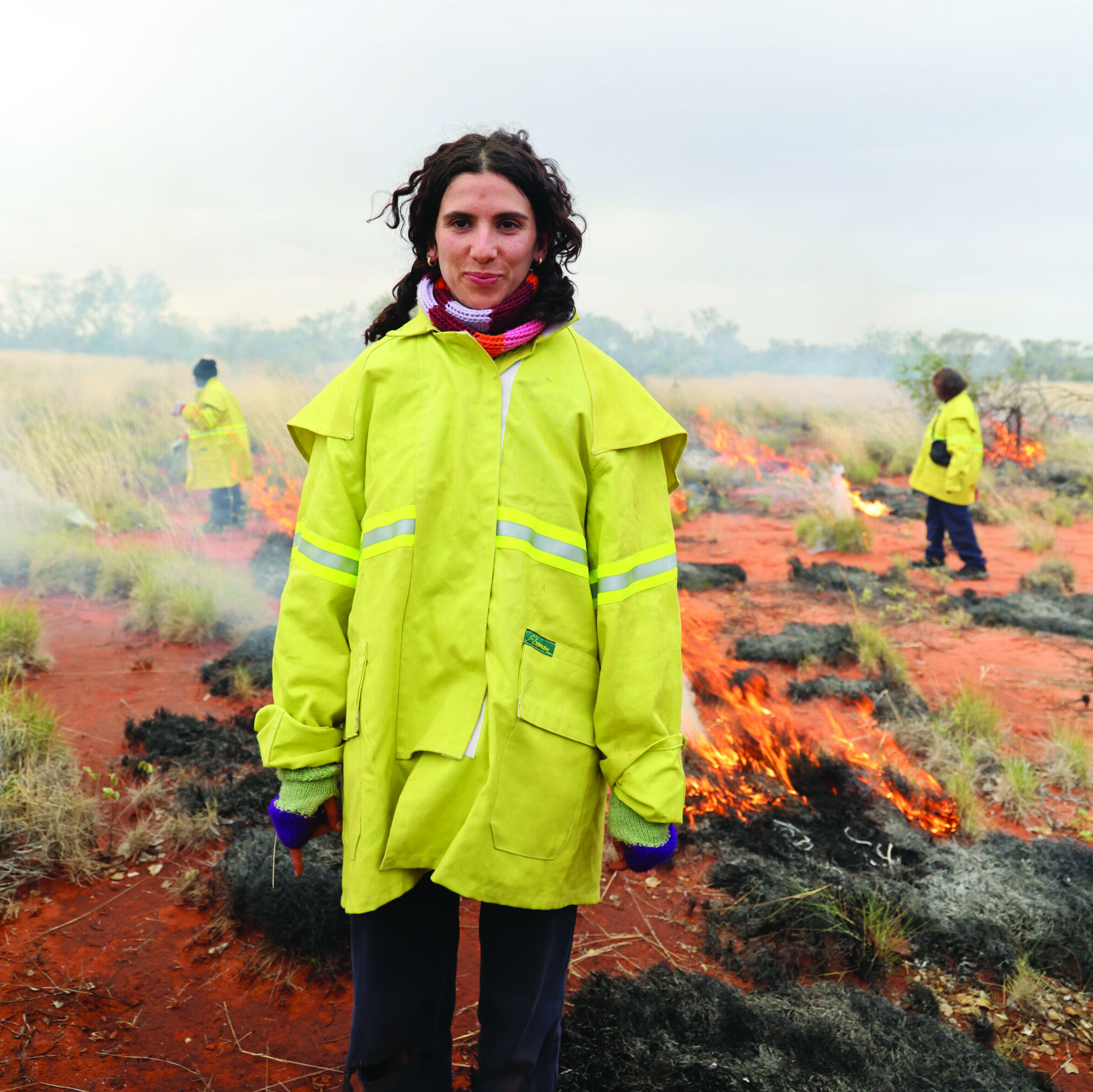
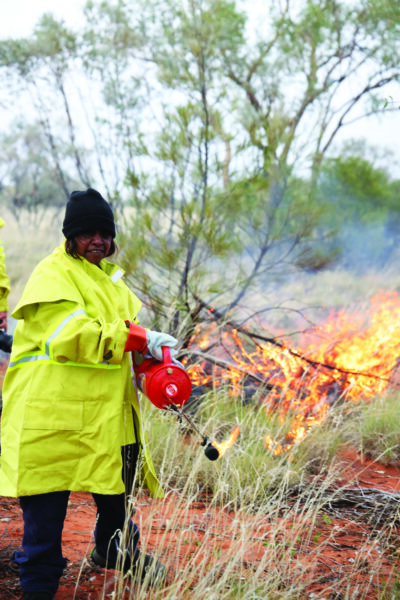
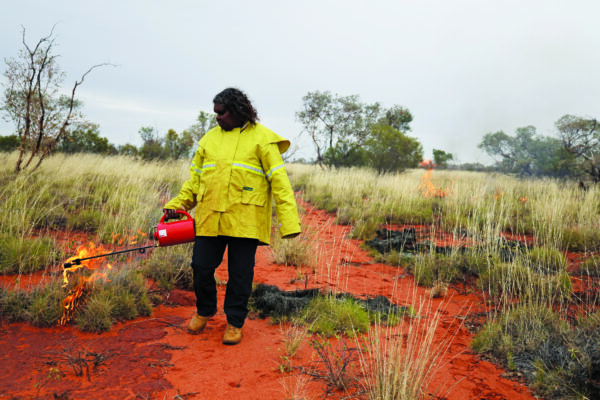
The rangers showed the interns different burning techniques.

“There was a beautiful moment where [traditional owner] Sam started lighting matches and then a couple of rangers followed him. Then Helen [Kunoth] brought me over and showed me her technique of getting a big stick, lighting that on fire, winking at me,” Ms Bannister said.

“It’s been incredible, the rangers have been so welcoming, so funny and so generous in sharing their knowledge. I’ve loved every second of it.”

The four-week program began with a week-long intensive induction process at the IDA Desert Hub in Perth, where the eight interns met staff and were prepared for the field-based elements of the program, including the cultural and ecological aspects of Indigenous land management.

The IDA then placed interns with member ranger groups across the desert for two weeks of on-country experience, before a final week of reflection and debriefing in Perth.

Helen Kunoth showed off her fire lighting capability.

The program is about matching the right people with the right land management jobs when there are no local Aboriginal applicants.

“The internship was created in response to IDA members and desert ranger teams who wanted better support for bringing new people into the sector right way,” the IDA’s sector development manager, Zack Wundke said.

“This way, they can get hands-on experience, decide if it’s right for them, and, if it is, start building the relationships and skills they’ll need to succeed.”

Ms Bannister, a trained nurse from Broome, wanted to test whether she was ready for a career change.

“When this internship popped up, I thought what a great opportunity to give it a go and see if I’m good for it. The biggest lesson has been to step back, watch, listen and observe. Being able to do that trumps all your qualifications.”

Ms Rotenberg, from Melbourne, has a master’s degree in environmental management and would like to work with Indigenous knowledge.

“I’ve learned that ranger work isn’t just about burning or weed control, it’s about being on country, telling stories and passing on knowledge. The women here have been so generous with me, showing me bush medicine plants and telling me whose country we’re on. I didn’t expect them to be so open, so quickly.”

On one school trip, the women taught children plant names in Alyawarre while the men lit fires in the background.

“It was beautiful,” Ms Rotenberg said. “The kids were excited, and the ladies just looked in their element. Everyone was so into it and looked glowing and happy to be out of the classroom. It was really nice to watch.”

Utopia’s ranger facilitator, Paul Evans, compared the program with an apprenticeship. “It’s a deep, hands-on introduction. New coordinators and facilitators need time to build trust and respect with countrymen and women, that’s the foundation. Without it, people can come and go quickly, which can leave a long-term impact on the community.”

The program is part of building the steady leadership that helps rangers to take on more senior positions. “When facilitators stay for the long haul, they form strong relationships with rangers, share valuable skills, and help build the confidence needed for rangers to step up and take on those roles themselves,” says the Central Land Council’s Boyd Elston, who also chairs the Indigenous Desert Alliance.

Rita Pula drew on her fire burning skills to light up the land.

A Land Rights News article

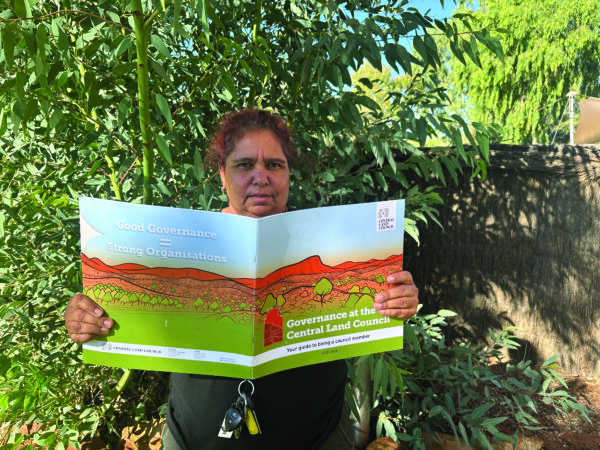
Helen Wilson would like a good governance book similar to this one for the CLC’s rangers.

Few newly-elected Central Land Council delegates get through their first council meeting without a peek in the how-to-manual for being a council member.

Each table has copies of the illustrated booklet Governance at the Central Land Council and many members like to look them up when they have questions.

They usually have lots of them: ‘Why do we check if we have a quorum and what is a quorum anyway?’

‘How do I know if I’ve got a conflict of interest and what do I do about it?’

‘What is a proxy and why might I need one?’

The CLC’s good governance guide has all the answers because it is based on years of feedback from CLC members.

It has been around for almost two decades, but the third edition is the best one yet.

So good, in fact, that Helen Wilson from the Lajamanu-based Northern Tanami Rangers has asked to take copies back to her community.

“I would like to have a book like that for all the rangers,” she said. “So we can learn about governance too and about how the CLC works. There’s no big words in the book, so it’s all plain English. They broke it down so it’s good to read. I might read it to my kids and teach them.”

“I think this book is really good – what governance means to us. It will bring a lot of learning and teaching to the younger ones, like my age, and everyone else.”

The lead ranger has been thinking on and off about representing her community on the council someday, once she moves on from ranger work.

When she visited the Uluru–Kata Tjuta National Park on other business in April she attended parts of the CLC’s induction and governance training day and started to leaf through the guide.

“The writing is all right, not too long and not too short. The pictures in the book are of local people, so that’s good.”

Another fan of the guide is governance trainer Maggie Kavanagh who ran the council induction during the first meeting of the CLC’s 2025-28 council term.

Ms Kavanagh has followed the development of the guide for many years and believes the latest edition shows that the council is taking governance support seriously.

“It is comprehensive, user friendly, has great graphics and is a terrific hands-on resource for council members to learn about their job,” she said.

Read the digital copy of Governance at the Central Land Council