

A landmark water rights case is before the High Court of Australia.
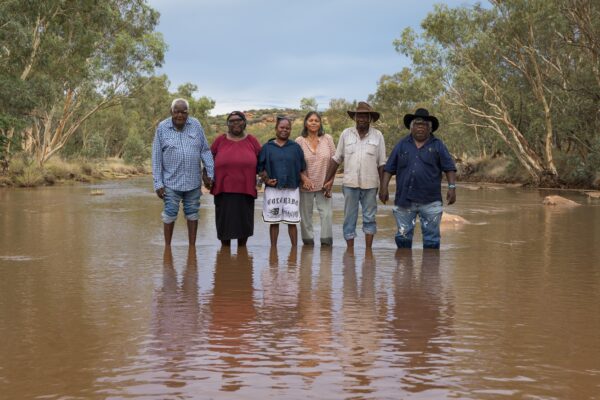
Six native title holders from the Mpwerempwer [pronounced Em BOORM Boora] Aboriginal Corporation will attend tomorrow’s hearing in Canberra and challenge the groundwater licence of a horticulture company that wants to grow fruit and vegetables in the desert south of Tennant Creek.
The licence authorises Fortune Agribusiness to extract 40 gigalitres of groundwater at Singleton Station every year for 30 years once it’s running at full capacity, making it the largest groundwater licence issued in the Northern Territory. After 30 years, this volume of groundwater will equal draining Sydney Harbour twice.
Experts value the water at between $70 million and $300 million, yet the NT government is granting the licence free of charge to Fortune Agribusiness. The company plans to use the precious water to grow crops, largely for international export.
The case marks a critical moment in the six-year legal battle by the region’s traditional owners, who say the project threatens sacred sites, cultural survival and a fragile desert water system.
The licence allows groundwater drawdown across thousands of hectares. The traditional owners warn that it risks permanently damaging an ancient aquifer, at least 40 groundwater-dependent sacred sites and community water supplies.
When groundwater levels drop below the reach of roots of sacred trees and plants, they die. Animals connected to dreaming stories disappear. Cultural practices that have continued for thousands of years are disrupted, causing deep emotional, social and physical distress for those responsible for this country.
Alyawarr traditional owner and 2026 Order of Australia medal recipient Frankie Holmes, who will attend the hearing, said water is central to people’s identity and survival.
“It’s water that’s special and it’s just not replaceable. It must be looked after. Our body and our blood and everything depends on water. Without water, we finish,” Mr Holmes said.
He emphasised the cultural responsibility passed down through generations.
“Looking after land and country, especially sacred trees, is very, very important for us. Ancestors hand it over to us to look after these waters and these lands. This is important to keep it going and for us to keep passing it on.”
Native title holder and Mpwerempwer director Dawn Swan said the High Court’s decision to hear the case gave her hope.
“Finally, someone is listening. I am very happy. We have people living on the land and this is their dream to stay here for future generations,” she said.
“This has been a long journey, and we will continue to fight for our sacred sites and culture,” she said.