

This article was originally published in the July 2026 issue of Land Rights News.
St John Ambulance is making some big changes. The push comes as paramedics continue to face regular abuse and assault, especially in Mparntwe (Alice Springs).
In the first four months of this year, there were 30 attacks on paramedics in Mparntwe. Most happened between late afternoon and midnight, in the middle of town. The attackers were often bystanders, and most were women.
Senior paramedic Matthew Cowie said it wasn’t always like this, and that violence against paramedics has only seen an uptick in the past five years. Mr Cowie oversees the service’s new occupational violence campaign ‘Protect Our Ambos’ which aims to keep paramedics safe as they save lives. Improving cultural safety and building stronger relationships with the community are key parts of this.
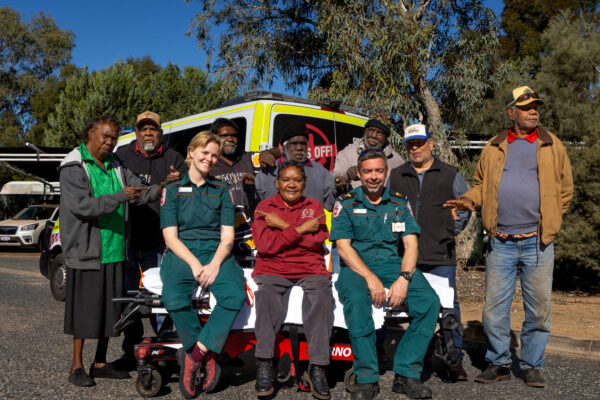
St John Ambulance plans to hire five Aboriginal liaison officers by September. The role is new to the ambulance service and means officers will ride in the ambulance with paramedics. “Their role will be to help provide cultural safety and awareness to our crews and to our staff, but also to the community,” Mr Cowie said.
He said this model has seen great success in other sectors, such as the Mparntwe Hospital, with patients visibly relaxing when Aboriginal liaison officers explain medical terms with a familiar language and cultural lens. Mr Cowie hopes the officers can help avoid misunderstandings, especially when people are anxious or unfamiliar with ambulance treatment.
Paramedics are also seeking to make stronger connections with communities in town and out bush, to improve relationships between ambos and potential patients, and increase trust in the service.
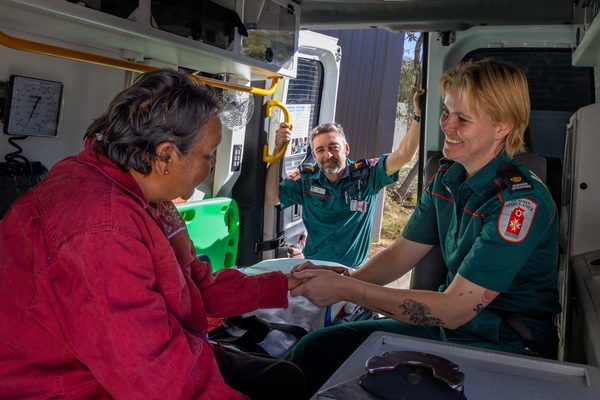
St John is also considering changes to the look of ambulances and uniforms, and working with Aboriginal organisations including the Central Land Council, Tangentyere Council, Congress, Lhere Artepe, Central Desert Council and the National Indigenous Australians Agency to improve culturally safe care. “We’re asking, how can we improve to make us more inclusive to our Indigenous community? Ninety per cent of our clients are Aboriginal. So really, if that’s your majority, you should move towards the majority that you’re servicing,” said Mr Cowie.
A quarter of Mparntwe’s paramedics leave every year. Replacing them is hard. Keeping experienced paramedics is important, said Mr Cowie, “there is that bit more community standing with people who have been here for a while. There is that cultural awareness, that cultural respect, and mutual respect.”
Around half of the town’s paramedics are newly graduated interns. “We’re getting quite junior staff and they’re not from Alice Springs the majority of the time. The majority are from capital cities,” Mr Cowie commented. He said these new staff have less cultural awareness and this affects peoples’ trust in the service. Keeping paramedics safe leads to more experienced, culturally aware staff. “We’ve got a lot of paramedics who love what they do and want to help the community,” Mr Cowie said, “but if they don’t feel safe, they’re not going to stay around.”
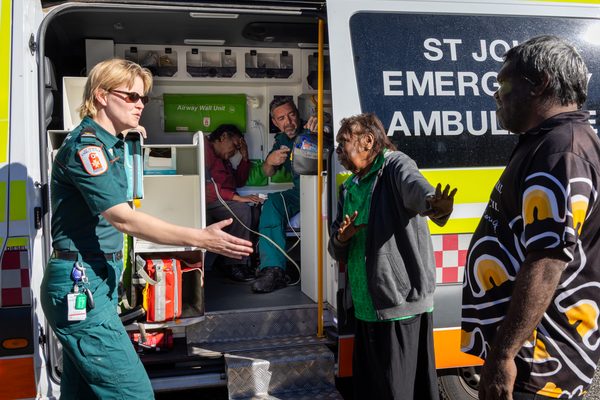
Negative media coverage of violence also stops paramedics from applying to work in Mparntwe. On 30 April, the town’s ambulance service shut down for four hours when rioters outside the hospital attacked paramedics and damaged ambulances. Mr Cowie said the service had no other choice. “We had to, for the safety of our paramedics. If we’re injured, we can’t help anyone.” He says he has never seen this happen in his two decades as a paramedic and doesn’t want it to happen again.
Amid the chaos of that night, CLC chair Warren Williams stood between the paramedics and rioters, calling for calm. He is now asking the community to protect paramedics.
“We need to protect our people and get them to hospital as quickly as possible,” he said. “Paramedics are there to do a service to their community.”
He said bystanders who hinder or attack paramedics risk patient lives.
“You can’t hold them back. That person is at risk, they need attention. The paramedics are there to do a job. They need space, and it’s your call if they can do their work.”
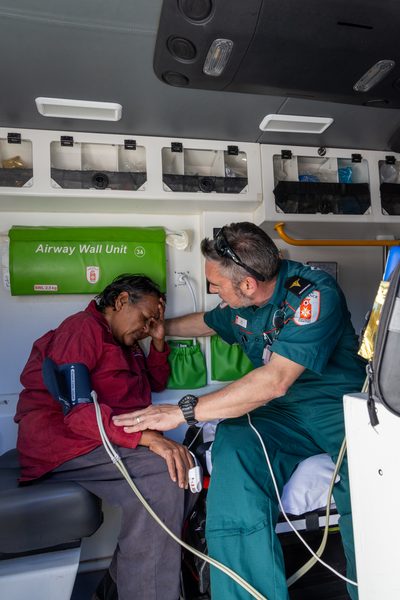
Luckily during the shutdown only two emergency calls came in: a woman in labour who was able to be escorted through the crowd into the hospital, and a baby sick with croup, whose parents managed to bring him through a separate entrance. Their car was destroyed in the riot.
Mparntwe only has three ambulances running at any one time. Each costs $300,000. When one is damaged, there are limited backups. Repairs take a long time as specialist parts must be ordered. On the night of the riot, four Mparntwe ambulances were damaged.
For paramedics, the violence can have lasting effects. “The unfortunate events that happened on the 30 April took one of our paramedics out for two weeks,” said Mr Cowie. “April brought back trauma from a previous incident where rocks were thrown at their ambulance, and just the banging and the noise and the yelling and the screaming – they had to take some time off. You do have that PTSD [post-traumatic stress disorder] that can develop, same as the military.”
Mr Cowie said the message from the ambos is simple. “We are here for the community, and we are part of your community, but we can’t help you if we are not safe.”